
 Skip to content
Mental health practices play an important role in the healthcare system, but providing excellent behavioral healthcare is only one part of running a successful practice.
Providers also need a reliable financial process.
Every appointment can involve eligibility verification, insurance benefits, authorization requirements, clinical documentation, diagnosis coding, procedure coding, claim submission, payment posting, denial management, patient balances, and accounts receivable follow-up.
When any part of this process breaks down, reimbursement can be delayed.
That’s why many psychologists, psychiatrists, therapists, counselors, social workers, and behavioral health organizations explore mental health billing services in the United States to manage administrative responsibilities more efficiently.
A professional billing team can help organize the revenue cycle from the first patient encounter through final payment.
The goal isn’t simply to submit more claims. The goal is to submit accurate, compliant, properly supported claims and follow them through the payment process.
For healthcare providers, even small billing problems can become expensive when they happen repeatedly.
A missing modifier, incorrect payer information, eligibility issue, authorization problem, coding error, or incomplete documentation can potentially lead to a rejected or denied claim.
Over time, these issues may contribute to growing accounts receivable and inconsistent cash flow.
The right billing strategy can help practices identify these problems earlier.
Mental health billing involves more than entering CPT codes into a practice management system.
Behavioral health providers work with multiple insurance companies, government programs, employer-sponsored plans, self-pay patients, and different reimbursement policies. Each payer may have specific requirements for claims, documentation, authorization, and provider participation.
A well-managed billing process therefore needs both technical knowledge and careful attention to detail.
Mental health services have their own coding, documentation, and reimbursement considerations.
A behavioral health provider may bill for psychotherapy, psychiatric diagnostic evaluations, family therapy, group therapy, psychological testing, medication management, or other covered services depending on the provider’s credentials and scope of practice.
The service delivered must be properly documented and represented by the appropriate billing codes.
At the same time, insurance policies can differ.
For example, one payer may have specific authorization requirements for certain services, while another payer may handle them differently.
This means that behavioral health practices need an organized process for checking payer requirements before services are provided whenever possible.
Some of the most common challenges include:
One small error may seem harmless.
However, repeated errors across hundreds of claims can create significant revenue leakage.
Professional mental health billing services in the United States are designed to support the administrative and financial side of behavioral healthcare.
Depending on the provider and contract, a billing company may assist with:
The exact services vary by company, so practices should clearly define responsibilities before signing an agreement.
A billing operation should prioritize accuracy over simply increasing submission volume.
A clean claim is generally easier to process than a claim that contains incorrect or incomplete information.
This is where experienced billing specialists can make a difference.
They can review patterns, identify recurring errors, communicate with providers, and help establish processes designed to reduce avoidable billing problems.
A complete behavioral health billing solution can cover the entire revenue cycle.
Instead of treating claim submission as the final step, professional billing teams typically look at the process from patient intake through reimbursement.
Eligibility verification is one of the most important front-end billing activities.
Before providing services, staff can verify whether the patient’s insurance is active and determine available benefits.
Important information may include:
Verifying this information early can help reduce unexpected billing problems later.
Some behavioral health services may require prior authorization or other payer approval.
Missing authorization can create reimbursement problems.
A billing team can help track authorization requirements, expiration dates, approved visits, and related payer communications.
Practices should still maintain appropriate clinical and administrative responsibility for ensuring services meet payer requirements.
Accurate coding is central to healthcare reimbursement.
Mental health billing commonly involves CPT and ICD-10-CM codes, although the appropriate codes depend on the service provided, provider qualifications, payer rules, documentation, and applicable coding guidance.
Coding should accurately reflect the service documented in the medical record.
It shouldn’t be selected simply because a particular code pays more.
Once services are coded and charges are entered, claims can be submitted electronically through an appropriate clearinghouse or payer channel.
A professional billing process includes reviewing claims for common errors before submission.
The goal is to reduce preventable rejections and ensure claims contain the information required by the payer.
Denied claims shouldn’t simply be written off.
A strong denial management process identifies why the claim was denied and determines whether the issue can be corrected or appealed.
Common denial reasons can include:
Tracking denial reasons over time can reveal patterns.
For example, if a practice repeatedly receives eligibility-related denials, the solution may be improving front-end verification rather than repeatedly correcting claims after submission.
Accounts receivable represents money that has been billed but hasn’t yet been collected.
AR management involves reviewing unpaid claims, identifying aging accounts, contacting payers, correcting claims, submitting appeals when appropriate, and monitoring outstanding balances.
A structured AR process often separates accounts by aging categories, such as:
| Aging Category | Management Focus |
| 0–30 days | Normal claim processing |
| 31–60 days | Claim status review |
| 61–90 days | Increased payer follow-up |
| 91–120 days | Escalated investigation |
| 120+ days | Intensive recovery and resolution |
The exact workflow should reflect payer processing times and the practice’s policies.
Outsourcing billing doesn’t automatically solve every financial problem.
However, when a qualified billing partner has appropriate systems, trained staff, clear accountability, and effective communication, it can provide meaningful operational benefits.
One of the primary goals of mental health billing services in the United States is to help providers receive appropriate reimbursement in a timely manner.
Faster claim submission, consistent follow-up, accurate payment posting, and active AR management can help reduce unnecessary delays.
Cash flow matters because healthcare practices have ongoing expenses.
Rent, payroll, software, insurance, supplies, marketing, utilities, and other operating costs don’t stop simply because an insurance claim hasn’t been paid.
A predictable revenue cycle can therefore provide greater financial visibility.
Clinicians generally want to spend their time providing care rather than tracking unpaid claims.
When administrative billing responsibilities consume too much time, providers and office staff may become overwhelmed.
Outsourcing some or all billing functions can allow internal teams to focus on:
This can be particularly useful for smaller practices where one employee may otherwise be responsible for several administrative roles.
Experienced billing professionals work with claims every day.
That repeated exposure can help them recognize common errors and payer-specific patterns.
A quality billing process should include internal checks for:
Accuracy isn’t just about avoiding denials.
It also supports cleaner financial reporting and more reliable revenue forecasting.
Revenue cycle management, or RCM, connects the financial steps of healthcare delivery.
A typical cycle includes:
Patient Scheduling → Registration → Eligibility → Authorization → Service → Documentation → Coding → Claim Submission → Adjudication → Payment Posting → Denial Management → AR Follow-Up
When these steps operate independently, problems can fall through the cracks.
An integrated approach gives practices a clearer view of where revenue is being delayed or lost.
Good mental health billing services in the United States should provide useful reporting rather than simply sending occasional spreadsheets.
Depending on the agreement, useful KPIs may include:
Reports should help the practice make decisions.
Numbers without interpretation aren’t particularly useful.
A billing partner should explain what the numbers mean and identify areas that deserve attention.
Not every billing company provides the same level of service.
Before selecting a partner, behavioral health providers should evaluate experience, technology, communication, security, pricing, reporting, and accountability.
Mental health billing requires knowledge of behavioral health services and payer requirements.
Ask prospective billing companies:
Experience doesn’t guarantee results, but it can reduce the learning curve.
Modern billing operations often depend on electronic health records, practice management systems, clearinghouses, payer portals, and secure communication systems.
Ask whether the billing company can integrate with your existing technology.
Important considerations include:
Billing companies may use different pricing models.
Common approaches include:
Don’t evaluate pricing alone.
Compare the services included in the fee and understand whether there are additional charges for credentialing, eligibility verification, denial appeals, patient statements, or other services.
Communication can make or break an outsourcing relationship.
A provider should know:
A reliable billing partner should feel like an extension of the practice rather than a black box.
Coding is one of the most technical parts of behavioral health reimbursement.
The appropriate code depends on the actual service performed and documented.
Providers and billing teams should use current official coding guidance and payer policies rather than relying on outdated code lists.
Psychotherapy services may be represented by different CPT codes depending on factors such as:
A billing professional should verify the current coding requirements applicable to the claim.
Psychiatric practices may bill evaluation and management services and other behavioral health services depending on provider qualifications and the services performed.
Coding should be supported by appropriate documentation.
Healthcare coding rules can change.
For Medicare-related information, providers can consult official CMS resources, including its physician fee schedule and billing guidance. CMS Physician Fee Schedule
CMS explains that the Physician Fee Schedule is a primary payment method for many professional services provided by physicians and other healthcare professionals.
Because payer policies and annual updates can affect reimbursement, practices should verify current requirements rather than depending on older articles or unofficial code lists.
Strong mental health billing services in the United States should be proactive.
The objective isn’t simply to fix claims after they fail. It’s to identify problems early and build processes that reduce avoidable errors.
The front end of the revenue cycle has a major influence on what happens later.
Start with accurate:
If incorrect information enters the system, that error can follow the claim all the way through the billing process.
Claims should generally be submitted according to payer requirements and the practice’s internal workflow.
Delays can increase AR and create unnecessary administrative work.
A daily charge review process can help identify services that haven’t yet been billed.
A denial report is more useful when it identifies trends.
For example:
| Denial Pattern | Possible Process Improvement |
| Eligibility | Improve verification |
| Authorization | Strengthen authorization tracking |
| Coding | Review coding workflow |
| Timely filing | Monitor claim submission |
| Provider enrollment | Review credentialing records |
| Missing information | Improve claim scrubbing |
| Duplicate claim | Review submission controls |
The goal is to fix the process behind the denial, not just the individual claim.
AR follow-up should be organized by payer, age, balance, and denial status.
High-value claims may require priority attention.
Old claims should not be allowed to sit indefinitely.
A structured follow-up schedule can help billing teams determine when to:
Not all payers behave the same way.
A practice can analyze:
This information can help leadership understand which parts of the revenue cycle require additional attention.
Credentialing and billing are closely connected.
A provider may have excellent clinical skills, but inaccurate enrollment information can create reimbursement problems.
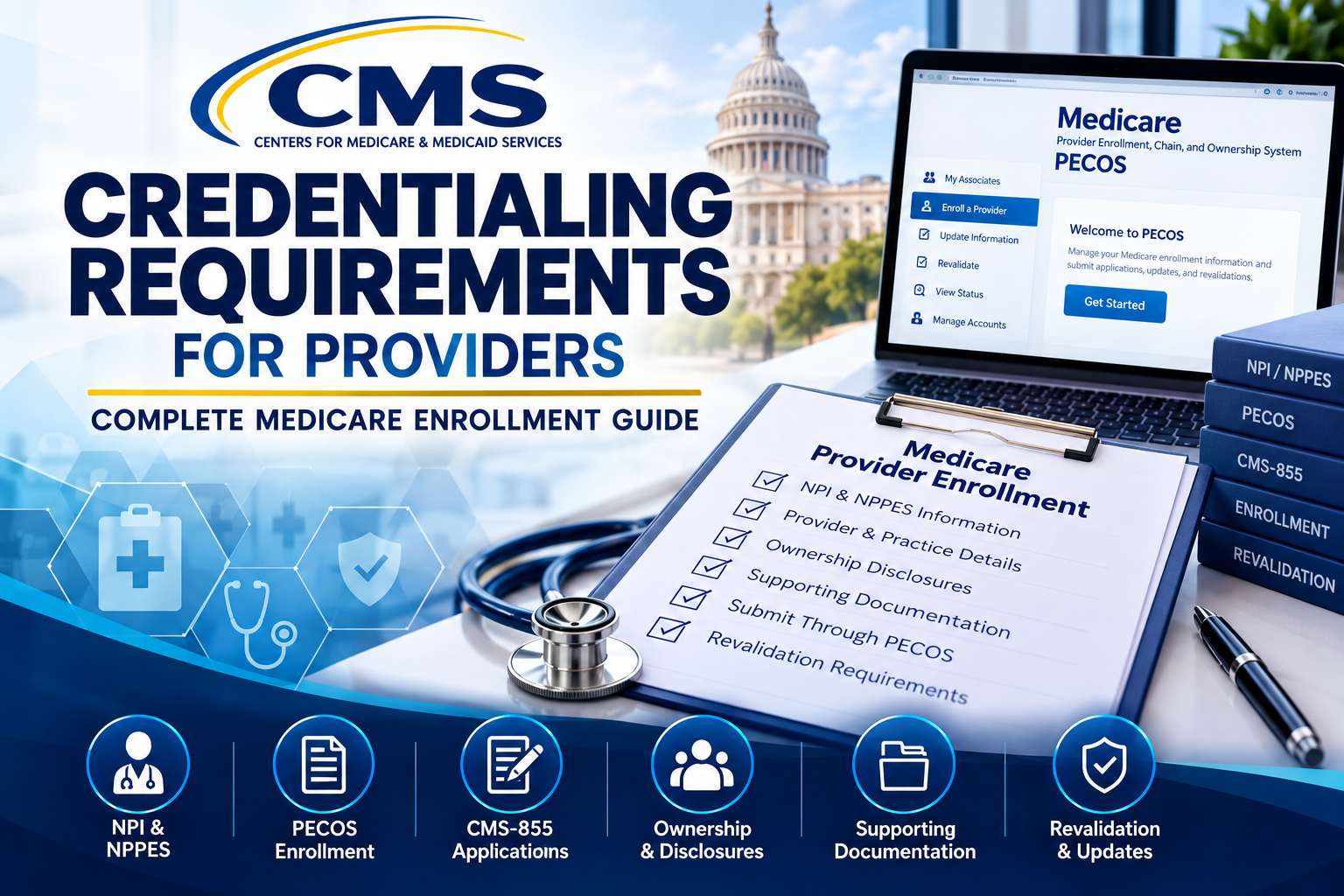
CMS notes that providers enrolling in Medicare generally need an NPI and must complete the applicable Medicare enrollment process through PECOS.
That’s why credentialing maintenance, payer enrollment, demographic updates, and billing operations should communicate with one another.
For some practices, outsourcing mental health billing services in United States isn’t simply about reducing administrative work.
It can be a strategic decision.
A growing practice may need more billing expertise than its current staff can provide.
A small practice may not want to hire a full-time billing department.
A multi-provider behavioral health organization may need standardized processes across multiple locations.
Outsourcing can provide access to trained billing professionals without requiring the practice to build every function internally.
Outsourcing may be worth considering when:
A strong billing company should provide more than basic claim submission.
Ideally, the relationship should include:
The provider should also remain involved in clinical documentation and other responsibilities that cannot simply be transferred to a billing company.
Mental health billing services are administrative and revenue cycle services designed to help behavioral health providers manage insurance verification, coding, claim submission, payment posting, denials, accounts receivable, and related billing activities.
Behavioral health billing can involve different payer rules, coding requirements, authorization policies, documentation standards, provider enrollment requirements, and reimbursement processes. These factors can make billing more complex than simply submitting a claim after every appointment.
Yes. A professional billing team can help identify common denial causes, improve claim accuracy, monitor payer requirements, correct rejected claims, and manage appropriate appeals. However, no billing company can guarantee that every claim will be paid.
Billing directly affects when a practice receives reimbursement. Accurate claims, timely submission, consistent follow-up, payment posting, and AR management can help reduce unnecessary payment delays and improve financial visibility.
It can be a practical option if the provider or internal staff doesn’t have enough time or expertise to manage billing effectively. The practice should compare outsourcing costs with the administrative time, staffing requirements, and potential revenue impact of handling billing internally.
Look for behavioral health experience, knowledgeable billing staff, secure technology, transparent pricing, reliable communication, detailed reporting, denial management, AR follow-up, and a clear understanding of your payer mix.
Some companies offer credentialing and payer enrollment in addition to billing, while others don’t. If credentialing is important to your practice, confirm exactly which enrollment and maintenance services are included.
Eligibility verification is extremely important because it helps identify coverage status, benefits, network information, and potential authorization requirements before or around the time services are provided. Strong front-end verification can help reduce avoidable billing problems.
Accounts receivable is money owed to the healthcare practice for services that have already been billed but have not yet been collected. AR management involves tracking outstanding claims, investigating delays, correcting problems, and pursuing appropriate reimbursement.
Start with accurate patient registration, consistent eligibility verification, proper authorization management, accurate coding, timely claim submission, systematic denial management, payment posting, and regular AR follow-up. Tracking key performance indicators can also help identify areas for improvement.
Author: Michael Clarke