 Skip to content
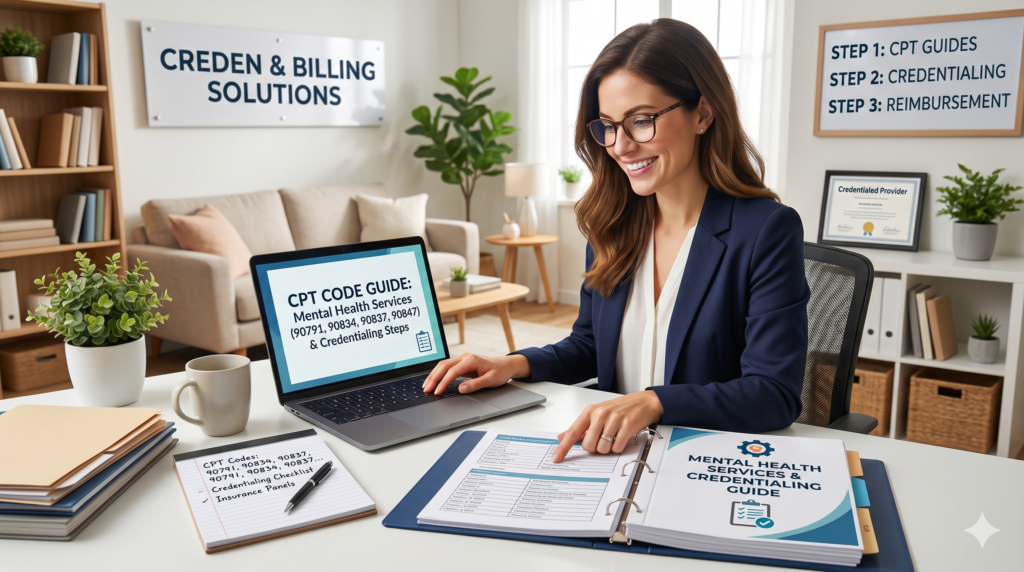
Mental health services are more important than ever, and accurate billing is the backbone of a successful practice. This CPT Code Guide for Mental Health Services & Credentialing will help you understand how to bill correctly, stay compliant, and boost your revenue.
CPT (Current Procedural Terminology) codes are used by healthcare providers to describe services performed. In mental health, these codes cover therapy sessions, evaluations, crisis care, and more. Without proper coding, claims can be denied, delayed, or underpaid.
Let’s be real—billing can feel confusing at first. But once you understand the structure, it becomes much easier to manage. This guide breaks everything down in a simple, practical way so you can apply it immediately.
Credentialing is the process of verifying a provider’s qualifications so they can join insurance networks. It includes checking licenses, education, work history, and certifications.
Without credentialing, providers can’t bill insurance companies. That means no reimbursements—simple as that.
Insurance panels are networks of approved providers. Once credentialed, you can:
Credentialing may take 60–120 days, so it’s best to start early. Many providers underestimate this step, but it’s critical for long-term success.
These are the starting point for most patients:
Use 90792 only if you’re prescribing medication or performing a medical assessment.
These are the most commonly used CPT codes:
| Code | Time | Description |
|---|---|---|
| 90832 | 30 min | Short session |
| 90834 | 45 min | Standard session |
| 90837 | 60 min | Extended session |
Time matters here. If your session runs 38 minutes, you should bill 90834, not 90832.
For providers offering medication management:
Example:
Used in emergency mental health situations. Documentation must clearly show urgency.
Psychological testing is another key service:
These codes are often underused but can significantly increase revenue when applied correctly.
Telehealth has become a game-changer in behavioral health.
| Code | Meaning |
|---|---|
| POS 02 | Telehealth (not home) |
| POS 10 | Telehealth (patient at home) |
Always verify payer-specific rules, as they can vary.
To support your CPT codes, documentation must include:
Avoid these common errors:
Poor documentation is one of the top reasons for claim denials.
Pro tip: Keep digital copies of all documents to speed up the process.
For official CPT coding guidelines, visit the American Medical Association (AMA):
https://www.ama-assn.org
The most common code is 90834, used for 45-minute therapy sessions.
No, only medical providers like psychiatrists and nurse practitioners can bill E/M codes.
90791 is without medical services, while 90792 includes medical evaluation and prescribing.
Typically 60 to 120 days, depending on the payer.
In many cases yes, but it depends on the insurance provider.
Common reasons include incorrect CPT codes, missing documentation, and lack of medical necessity.
Mastering CPT codes and credentialing isn’t just about compliance—it’s about growing your mental health practice. With the right knowledge, you can avoid costly mistakes, increase reimbursements, and provide better care to your patients.
This CPT Code Guide for Mental Health Services & Credentialing gives you a strong foundation to succeed. Whether you’re just starting out or looking to optimize your billing, these insights will help you stay ahead.