 Skip to content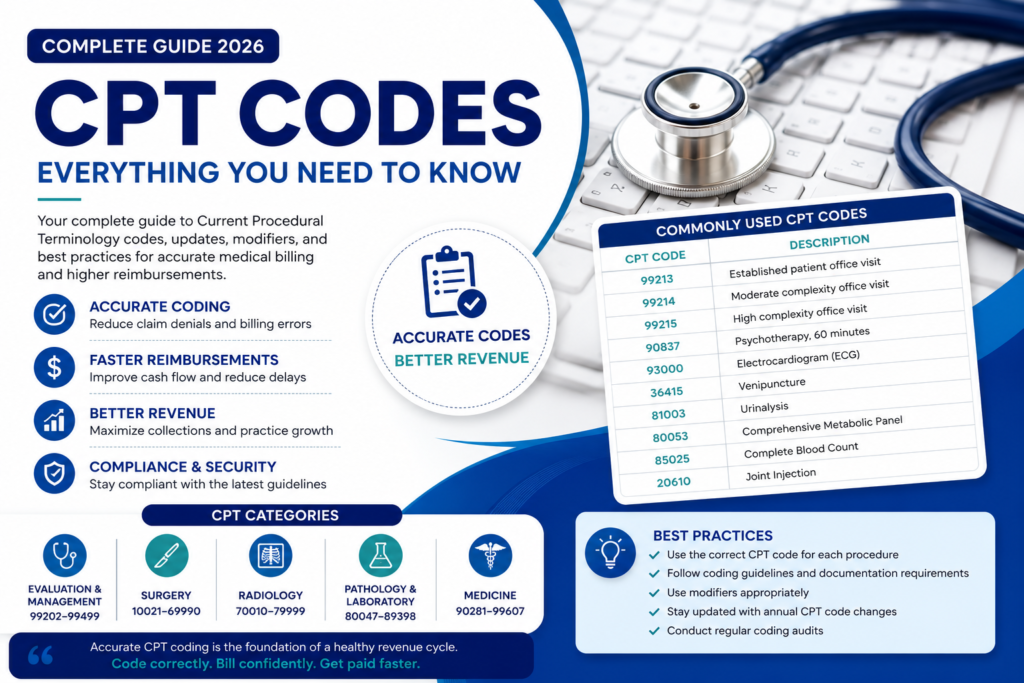
Current Procedural Terminology (CPT) codes are the backbone of medical billing and coding in the United States. Every healthcare provider, medical coder, and billing specialist relies on accurate CPT coding to submit insurance claims, receive reimbursements, and maintain compliance with payer requirements.
Incorrect CPT coding can lead to claim denials, delayed reimbursements, audits, and revenue loss. Understanding how CPT codes work is essential for improving your Revenue Cycle Management (RCM) and maximizing practice revenue.
CPT (Current Procedural Terminology) codes are standardized five-digit numeric codes developed and maintained by the American Medical Association (AMA). These codes describe medical, surgical, diagnostic, and evaluation services provided by healthcare professionals.
Insurance companies, Medicare, and Medicaid use CPT codes to determine reimbursement for healthcare services.
Using accurate CPT codes helps healthcare organizations:
Category I codes represent the most commonly performed procedures.
Examples include:
Category II codes are optional tracking codes used to measure quality of care.
These codes support value-based care reporting.
Category III codes cover emerging technologies and experimental procedures before permanent Category I codes are assigned.
99202–99499
00100–01999
10021–69990
70010–79999
80047–89398
90281–99607
| CPT Code | Description |
|---|---|
| 99213 | Established patient office visit |
| 99214 | Moderate complexity office visit |
| 99215 | High complexity office visit |
| 90837 | Psychotherapy (60 minutes) |
| 93000 | Electrocardiogram (ECG) |
| 36415 | Venipuncture |
| 81003 | Urinalysis |
| 80053 | Comprehensive Metabolic Panel |
| 85025 | Complete Blood Count |
| 20610 | Joint Injection |
Modifiers provide additional information about performed procedures.
Common modifiers include:
Correct modifier usage reduces denials and improves reimbursement.
Healthcare providers frequently encounter:
These mistakes often result in claim denials and payment delays.
Outsourcing medical billing helps practices:
Professional billing companies ensure accurate CPT coding while allowing providers to focus on patient care.
CPT codes are standardized medical procedure codes used for billing insurance companies.
The American Medical Association (AMA) develops and maintains CPT codes.
They are updated annually.
Yes. CPT codes describe procedures, while ICD-10 codes describe diagnoses.
Modifiers provide additional details about procedures and help ensure accurate reimbursement.
Accurate CPT coding is essential for successful medical billing, faster reimbursements, and reduced claim denials. By following current coding guidelines, maintaining proper documentation, and partnering with experienced billing professionals, healthcare providers can improve their financial performance and strengthen their revenue cycle.
If your practice needs help with CPT coding, medical billing, provider credentialing, or Revenue Cycle Management (RCM), partnering with an experienced medical billing company can help maximize collections and minimize administrative burden.
Author: Michael Clarke