
 Skip to content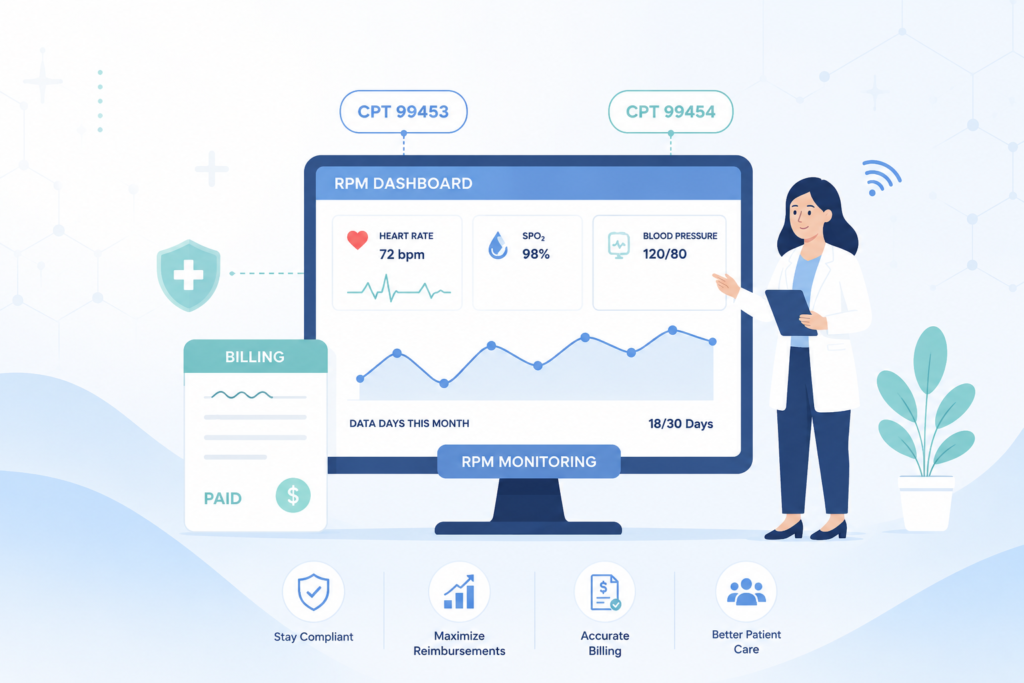
In 2026, RPM reimbursement brings important billing opportunities, including new CPT codes designed to cover patients who may not meet the traditional device-day or treatment-management thresholds.
For physicians, medical groups, billing teams, and healthcare organizations, understanding the latest RPM CPT codes, Medicare billing requirements, documentation rules, and reimbursement guidelines is essential for maximizing legitimate reimbursement while reducing denials and compliance risks.
Remote Patient Monitoring, commonly called RPM, uses connected medical devices to collect physiologic information from patients outside the clinical setting and electronically transmit that information to healthcare providers.
Common RPM measurements include:
RPM is frequently used to help manage conditions such as hypertension, diabetes, congestive heart failure, COPD, obesity, and cardiovascular disease, as well as certain acute or post-discharge conditions.
The key distinction is that Medicare RPM generally involves a qualifying connected medical device that electronically collects and transmits physiologic information rather than relying only on information manually reported by the patient.
Understanding the correct Remote Patient Monitoring CPT codes is the foundation of compliant RPM billing.
CPT 99453 covers the initial setup of the remote monitoring device and education provided to the patient regarding proper use of the equipment.
Typical services include device setup, patient onboarding, instructions on taking measurements, and education about transmitting data.
This is generally an initial RPM service rather than a recurring monthly device-supply code.
One of the most significant RPM reimbursement updates for 2026 is CPT 99445.
This code creates a reimbursement pathway for qualifying RPM device monitoring when data is collected and transmitted for 2–15 days during a 30-day period.
Previously, patients who did not reach the traditional 16-day threshold could present a reimbursement challenge. The new code provides greater flexibility for shorter monitoring periods when all applicable requirements are satisfied.
CPT 99454 covers the supply of an RPM device and the collection/transmission of physiologic data during a 30-day period.
For 2026, CPT 99454 generally applies when qualifying device data is collected for 16 or more days during the 30-day period.
Accurate tracking of transmission days is critical. Practices should maintain clear records showing that the required data threshold was satisfied before submitting the claim.
Another important addition for 2026 is CPT 99470.
This code addresses RPM treatment-management services totaling approximately 10–19 minutes during a calendar month, subject to applicable requirements.
The addition is important because it creates a billing pathway for clinically meaningful RPM management that does not reach the 20-minute threshold required for CPT 99457.
CPT 99457 covers the first 20 minutes of qualifying RPM treatment-management services during a calendar month.
These activities may include reviewing transmitted patient information, assessing trends, making care-management decisions, coordinating treatment, and communicating with the patient or caregiver.
A key requirement is interactive communication with the patient or caregiver during the month.
Simply reviewing RPM data without satisfying the communication and other requirements may not support billing the code.
CPT 99458 is an add-on code used for additional qualifying RPM treatment-management time beyond the initial period reported under CPT 99457.
This code can become particularly relevant for patients with complex chronic conditions requiring additional monitoring, clinical intervention, or care-management activity.
| CPT Code | RPM Service | General Threshold |
|---|---|---|
| 99453 | Device setup and patient education | Initial setup |
| 99445 | Device supply/data transmission | 2–15 days |
| 99454 | Device supply/data transmission | 16+ days |
| 99470 | Treatment management | 10–19 minutes |
| 99457 | Treatment management | First 20 minutes |
| 99458 | Additional treatment management | Each additional 20 minutes |
Providers should always verify current CMS guidance, Medicare Administrative Contractor requirements, and individual payer policies before submitting claims.
The biggest development is the expansion of RPM coding to recognize lower utilization thresholds.
Historically, two common barriers to RPM reimbursement were patients failing to reach enough device-transmission days and clinical management time falling below the established treatment-management threshold.
The introduction of CPT 99445 and CPT 99470 helps address those gaps.
This change can potentially make RPM programs more practical for patients who require shorter monitoring periods or less intensive monthly management while still receiving medically necessary remote care.
For healthcare practices, however, expanded reimbursement opportunities also make accurate RPM coding and documentation increasingly important.
Successful Medicare RPM reimbursement depends on more than selecting the correct CPT code.
Practices should establish consistent workflows for eligibility, consent, device qualification, monitoring, documentation, communication, and billing.
Patient consent should be obtained and properly documented according to Medicare and applicable payer requirements.
Patients should understand the RPM service, how monitoring works, their responsibilities, and any applicable cost-sharing obligations.
The patient’s medical record should clearly support why remote physiologic monitoring is medically appropriate.
RPM can be used for qualifying acute and chronic conditions, but documentation should establish the clinical reason for monitoring.
The monitoring technology should satisfy applicable Medicare requirements for an RPM medical device.
For traditional Medicare RPM, the device should collect physiologic information and electronically transmit the data rather than depend solely on manual patient reporting.
Practices must accurately track the number of qualifying days on which RPM data is collected and transmitted.
This is particularly important in 2026 because the number of monitoring days can determine whether CPT 99445 or CPT 99454 is appropriate.
For time-based RPM codes, clinical activities and time should be accurately documented.
Records should identify the services performed, time spent, relevant data reviewed, clinical actions taken, and required patient or caregiver communication.
Interactive communication remains an important component of RPM treatment management.
Practices should document the date, participants, nature of the communication, and clinically relevant outcome instead of simply noting that the patient’s data was reviewed.
There is no single reimbursement amount that applies to every practice.
RPM reimbursement rates in 2026 depend on factors including the CPT code billed, geographic locality, Medicare Physician Fee Schedule calculations, provider characteristics, and payer-specific contractual rates.
Therefore, providers should avoid relying solely on a national reimbursement estimate when forecasting RPM revenue.
The better approach is to verify reimbursement using the current Medicare Physician Fee Schedule and applicable payer contracts.
Even when RPM services are clinically appropriate, billing errors can result in delayed payments, denials, or compliance concerns.
Common problems include:
A well-designed RPM billing workflow should verify these requirements before a claim is submitted.
In appropriate circumstances, Remote Patient Monitoring and Chronic Care Management (CCM) may both be provided during the same month when the patient qualifies for each service.
However, providers must avoid double counting the same clinical staff time toward multiple services.
Separate services should be supported by appropriate documentation demonstrating what was performed and why it was medically necessary.
RPM programs can be especially valuable for patients who require frequent physiologic monitoring between office visits.
Potential candidates include patients with hypertension, diabetes, congestive heart failure, COPD, cardiovascular disease, obesity, and other conditions requiring ongoing monitoring. RPM may also be appropriate in certain post-discharge and acute-care situations.
Clinical eligibility alone is not enough. Patient engagement matters.
Practices should evaluate whether patients can consistently use the monitoring equipment, transmit the required data, and participate in necessary follow-up communications.
When properly implemented, Remote Patient Monitoring reimbursement can provide practices with recurring revenue while extending care beyond office visits.
However, RPM should not be viewed simply as another billable service.
Successful programs combine clinical necessity, patient engagement, compliant technology, accurate documentation, correct coding, claim management, and ongoing reimbursement monitoring.
A practice enrolling a large number of patients without an effective billing and compliance process may actually create additional administrative burden and denied claims.
Managing an RPM program requires coordination among providers, clinical teams, patients, technology platforms, and billing staff.
Nexa DigitalPro helps healthcare providers strengthen the revenue-cycle side of remote patient monitoring through accurate billing, coding support, eligibility verification, documentation review, denial management, and reimbursement follow-up.
Our healthcare support services include:
Medical Billing & RCM | RPM Billing Support | Provider Credentialing | Prior Authorization | A/R & Denial Recovery | Medical Virtual Assistance | Patient Support | Practice Analytics
Instead of allowing physicians and office staff to spend valuable time tracking billing requirements and unpaid claims, Nexa Digital Pro helps practices build a more organized reimbursement workflow.
If your practice currently offers RPM—or plans to introduce Remote Patient Monitoring in 2026—proper billing and documentation can make the difference between a successful program and recurring claim problems.
Nexa Digital Pro helps healthcare providers manage the revenue cycle so they can focus on their patients.
Revenue. Operations. Digital Growth. One Partner.
Important RPM codes include 99453, 99445, 99454, 99470, 99457, and 99458. They address different parts of RPM, including device setup, device-data transmission, and treatment-management services.
CPT 99445 is a 2026 RPM code associated with qualifying device monitoring involving 2–15 days of data within the applicable reporting period.
CPT 99470 provides a pathway for qualifying RPM treatment-management services involving 10–19 minutes during a calendar month.
The primary distinction involves the number of qualifying device-data days. CPT 99445 addresses the lower 2–15 day range, while CPT 99454 applies to 16 or more days, subject to applicable billing requirements.
CPT 99457 covers the first 20 minutes of qualifying RPM treatment-management services during a calendar month and includes an interactive communication requirement.
CPT 99458 is an add-on code for additional qualifying RPM treatment-management time beyond the initial time reported under CPT 99457.
Yes. Medicare reimburses qualifying RPM services when applicable coverage, medical necessity, device, documentation, and coding requirements are satisfied.
Yes. Medicare RPM is not limited exclusively to chronic diseases. Qualifying acute and chronic conditions may be monitored when RPM is medically necessary.
They may be billed during the same month when the requirements for both services are independently satisfied. The same clinical staff time should not be counted toward both services.
Practices should verify patient eligibility and payer requirements, document medical necessity and consent, confirm device-data thresholds, accurately record management time and interactive communications, use the correct CPT codes, and review claims before submission.
Author: Michael Clarke